


A signed document is not always a defensible one. When a transaction carries legal, financial, or operational risk, the real question is not just whether someone signed, but whether you can prove who signed, how that person was authenticated, and what evidence remains if the transaction is challenged. That is why identity verification matters in document signing. In higher-stakes workflows, a signature alone is not enough. Legal, compliance, security, and audit teams need a reliable way to link the transaction to the right individual and preserve the evidence behind that link.
That distinction matters in the United States because the ESIGN Act gives electronic signatures broad legal recognition, while still leaving room for questions about attribution, process, and record quality. Under 15 U.S.C. § 7001, a signature, contract, or record generally may not be denied legal effect solely because it is in electronic form. Under 15 U.S.C. § 7006, an electronic signature is defined broadly as an electronic sound, symbol, or process attached to or logically associated with a record and executed or adopted with intent to sign. That broad definition is part of what makes electronic signatures so useful. It is also why a valid e-signature is not automatically the same thing as strong identity assurance.
That is where weaker articles on this topic usually stop too early. Legal recognition matters, but it does not settle the harder question. If a signature is disputed, can you show that it was actually the act of the claimed signer?
For that, attribution matters. California’s enactment of UETA offers a useful example. Civil Code § 1633.9 states that an electronic record or electronic signature is attributable to a person if it was the act of that person, and that the act may be shown in any manner, including evidence of the efficacy of a security procedure used to determine the person to whom the electronic record or signature is attributable. In plain terms, the controls around the signing event help determine how defensible the result will be.
A signature field shows that a signing action occurred. By itself, it does not prove that the intended signer completed the action under appropriately controlled conditions.
In low-risk workflows, that may be acceptable. A routine acknowledgment or a simple internal approval may not justify a high-assurance process. But businesses often make the mistake of applying the same lightweight workflow to every document type. That is when the gaps start to matter.
Email-based signing links are a good example. They are efficient and often appropriate, but access to an email inbox is not the same thing as strong identity verification. Accounts can be shared. Access can be delegated. Links can be forwarded. Credentials can be compromised. Most of the time, none of that becomes visible during the transaction itself. It becomes visible later, when someone asks whether the signer was really who the business assumed they were.
That is why identity verification matters most in higher-risk workflows: vendor onboarding, payment instruction changes, sensitive HR records, regulated disclosures, high-value agreements, financial services documentation, and any transaction likely to be reviewed in a dispute or audit. In those situations, the real question is whether the organization can demonstrate that the right person signed through a process proportionate to the risk.
Identity verification strengthens document signing in three practical ways:
That risk-based view is consistent with current NIST guidance. NIST SP 800-63-4, finalized in July 2025, frames digital identity around assurance levels for identity proofing, authentication, and federation. Its companion publications split those functions more clearly: SP 800-63A-4 addresses identity proofing and enrollment, while SP 800-63B-4 addresses authentication and authenticator management. That structure is useful because it helps organizations think more precisely about what kind of control a given signing workflow actually needs.
Not every important document needs the same control stack.
Some workflows may only require stronger authentication, such as single sign-on tied to a managed enterprise identity, multi-factor authentication, or tighter recipient access controls. In other cases, the business may need more formal identity proofing, especially when the consequences of error, fraud, or repudiation are higher.
NIST’s current framework is helpful here because it separates identity proofing from authentication rather than treating identity as a vague checkbox. SP 800-63A-4 explains that during identity proofing, an applicant provides evidence to a credential service provider, which can then establish identity at a stated assurance level. SP 800-63B-4 focuses on authentication of a previously proofed subscriber and defines technical requirements for authenticator assurance levels. For document-signing strategy, that distinction matters. It helps teams choose controls based on the transaction rather than defaulting to a generic signing flow for everything.
This is also the more useful way to frame the topic for a global audience. Jurisdictions differ, and specific legal requirements vary by document type and market. But the core principle is stable: the more consequential the transaction, the more important it becomes to connect the signing event to the right person with evidence that will still hold up later.
A document-signing workflow is only as defensible as the record it leaves behind.
This is another place where superficial content tends to fall short. It focuses on execution and ignores preservation. But when a signed document matters, the post-signature record matters almost as much as the signature event itself.
The ESIGN Act addresses that directly. Under 15 U.S.C. § 7001(d), if a law requires a contract or other record to be retained, that requirement may be satisfied electronically only if the electronic record accurately reflects the information in the contract or record and remains accessible to those entitled to access it in a form that can be accurately reproduced later. The same section also includes detailed consumer consent rules for electronic disclosures in applicable consumer contexts. That is one reason document-signing compliance should never be reduced to simply capturing intent. Retention, accessibility, and process design matter too.
That is why stronger signing workflows ask better questions from the start:
Who is the intended signer?
How is that signer being authenticated or identity-verified?
What level of assurance does this document require?
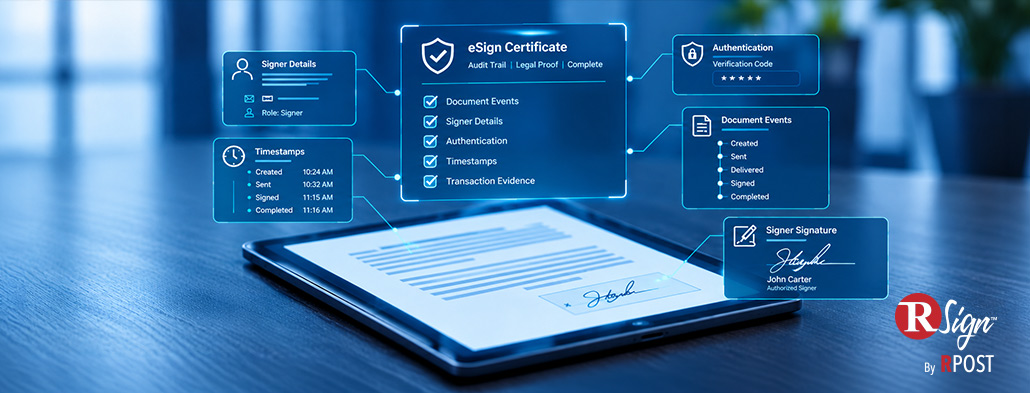
What evidence is being captured around the transaction?
Will the retained record still be persuasive months or years later?
Those are not abstract legal questions. They are practical business questions. They determine whether a signed document remains useful when it is challenged, audited, or relied on in a high-stakes setting.
RSign helps organizations move beyond basic e-signature workflows by adding stronger identity verification, clearer attribution, and better evidence retention to the signing process.
The result is a more reliable record of who signed, how the signing event was completed, and what documentation supports it afterward. That gives teams a stronger foundation for compliance, audit readiness, and dispute response without slowing business down unnecessarily.
Try RSign free and see how stronger identity verification can improve trust, accountability, and proof across your signing workflows.
October 19, 2026

September 22, 2026

August 20, 2026

July 20, 2026

June 24, 2026




 Blog
Blog