




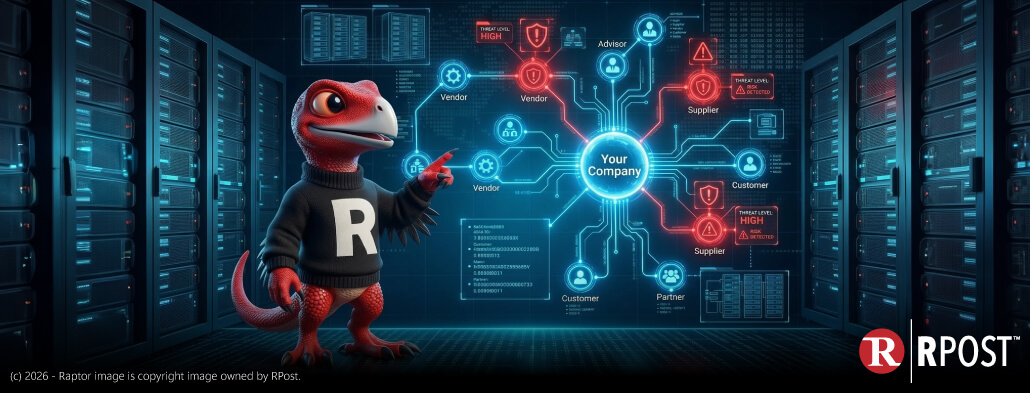
Rocky the Raptor here, RPost’s cybersecurity product evangelist, swooping in with a topic that doesn’t always get the spotlight it deserves until it’s too late: Third-party risk… and how it quietly affects your company’s valuation in an acquisition.
If you’re planning to be acquired, acquire someone else, or spin off a division, cyber risk hiding in your partner ecosystem can become a very expensive negotiating lever at the closing table. Let’s talk about why.
Most security programs obsess over protecting endpoints, servers, and internal users. That’s important. But here’s the uncomfortable truth my raptor eyes see every day: Most cybercrimes begin during reconnaissance outside your endpoints.
Cybercriminals don’t get inside by smashing the front door. They lurk quietly inside compromised supplier accounts, vendor email systems, partner devices, advisor collaboration tools, and customer inboxes. In other words, your third parties.
Once they see leaked email threads, documents, or context about who communicates with whom, they can craft hyper-targeted attacks that lead to BEC, supplier fraud, data exfiltration, ransomware, and payment diversion.
And here’s the kicker: you usually can’t see this reconnaissance happening. That invisibility is exactly what causes problems in M&A due diligence.
Picture this scenario. Your company is in late-stage acquisition discussions. Everything looks strong - revenue, growth, technology, market share. Then the acquiring company’s security team asks a simple question, “Show us your third-party risk program.”
If the answer is vague, incomplete, or nonexistent, two things happen immediately.
Now flip the situation. Suppose your company is selling a subsidiary or business unit. Suddenly, third-party risk becomes your defensive weapon.
If you have a demonstrable program in place, you know which third parties interact with your data, detect compromised accounts in partner environments, show active monitoring of leaks beyond endpoints, and demonstrate measurable security intelligence.
That means the buyer cannot easily claim unknown cyber exposure. And when that argument disappears, so does a major valuation discount lever.
Here’s where many organizations struggle. Traditional Third-Party Risk Management (TPRM) relies on things like vendor questionnaires, security audits, compliance attestations, and annual assessments. Those are useful, but they’re also static snapshots in time.
Cybercrime today moves much faster. Compromised accounts at suppliers or vendors can appear any day, any hour, without warning. So, CIOs are increasingly asking a smarter question: “Can we see third-party cyber risk in real time?”
That’s exactly where RPost built something new.
RPost’s RAPTOR™ AI approaches third-party risk differently. Instead of relying on surveys or audits, it looks at what actually happens to your content after it leaves your organization.
By simply hooking RAPTOR AI into the outbound email flow, it can observe when your emails or documents appear in compromised third-party environments, detect cybercriminal reconnaissance activity, identify compromised accounts or devices at partner organizations, and automatically stop leaked content before attackers see it.
From this activity, RAPTOR AI builds a dynamically updating third-party risk dashboard, showing:
In short, it turns your communication network into a real-time third-party risk intelligence map.
This concept aligns closely with conversations happening at the highest levels of cybersecurity leadership. At the Gartner CIO Leadership Forum, Distinguished VP Analyst Paul Proctor discussed frameworks for connecting cybersecurity programs to board-level risk conversations.
Some CIOs and CISOs we’ve spoken with are now exploring how RAPTOR AI’s real-time third-party risk insights could feed into Proctor’s well-known Protection Level framework.
Why? Because board members don’t just want compliance checklists. They want visible intelligence about risk exposure. And third-party ecosystems are increasingly where that exposure begins.
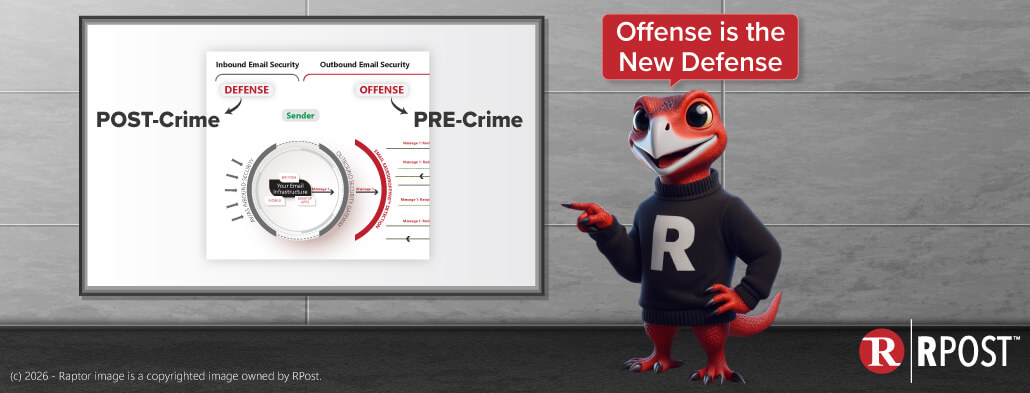
Analysts have increasingly recognized RPost for pioneering a concept we call PRE-Crime™ cybersecurity. Instead of waiting for attacks to hit your gateway, RAPTOR AI focuses on the reconnaissance phase, when attackers are quietly gathering intelligence.
RAPTOR AI can detect cyber reconnaissance beyond endpoints, kill leaked email threads and documents before attackers see them, identify compromised partner environments, and provide real-time third-party risk intelligence.
That means organizations can stop attacks before they start. And from a CIO perspective, it provides something equally powerful: Demonstrable cyber risk governance.
Artificial intelligence isn’t just helping defenders. It’s also helping cybercriminals. Attackers now use AI to craft highly contextual phishing lures by analyzing email threads, partner relationships, business processes, and communication timing.
Most of that intelligence comes from compromised third-party accounts, which is why modern cyber defense increasingly requires visibility beyond your endpoints.
Whether your organization is preparing for acquisition, acquiring another company, spinning off a division, or simply strengthening governance, third-party cyber risk visibility is no longer optional.
Without it, buyers will assume unknown risk and apply valuation discounts.
With it, you gain a powerful strategic advantage.
RAPTOR AI makes that possible with a simple hook-in to outbound email flow, producing real-time third-party risk intelligence, leak detection, and preemptive cybercrime disruption. Or as I like to say, “in cybersecurity and M&A, it’s better to be the raptor watching the ecosystem than the dinosaur surprised by the meteor.”
May 08, 2026
April 24, 2026

April 15, 2026
April 03, 2026
March 27, 2026





 Blog
Blog