




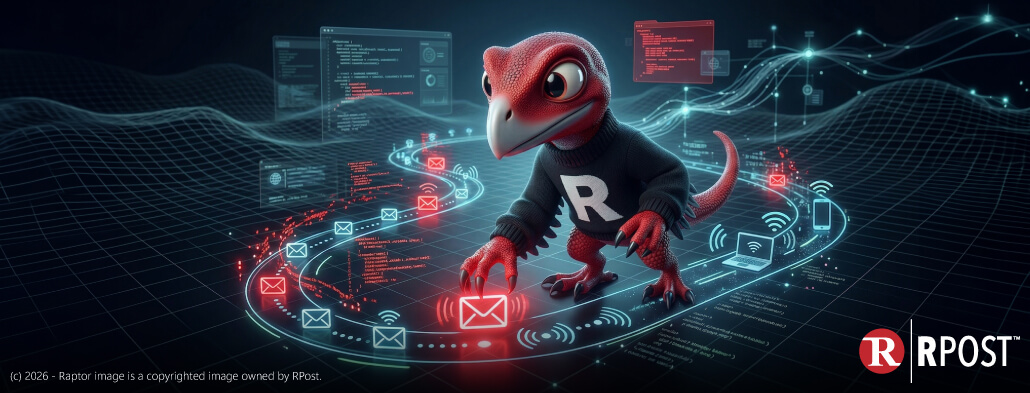
Rocky the Raptor here, RPost’s cybersecurity product evangelist. Today, what I’m about to tell you should rattle the boardroom glass…
There’s a new beast in the jungle: Claude Mythos AI from Anthropic. And this isn’t your everyday chatbot; this is an agentic, reasoning, code-writing, vulnerability-hunting machine. A system reportedly so powerful that it can be unleashed as a swarm of AI agents.
We seem to be entering into a new realm with how Anthropic is describing Mythos. It’s being positioned as an "ethical hacker." It will scour the dark web for leaked information, target high-value users, and do this tirelessly to find vulnerabilities - not to exploit organizations, but to alert them that they have vulnerabilities.
This is good for the world, right? But why then have they not released this to the public? Instead, it’s locked inside a controlled initiative, Project Glasswing - a limited-access cybersecurity program designed to secure critical systems. Why? Because even the creators know something that every seasoned security professional already understands: Anything powerful enough to defend… is powerful enough to destroy.
Enter the Adversary: Not Just Hackers - Ecosystems
Hackers and sophisticated cybercriminal cabals like Black Axe would be drooling at the ability to use this "ethical hacking" AI capability to find vulnerabilities and exploit. This will put even more pressure on the need for AI cybersecurity to counter AI turned to the dark side.
One of the tools is to see the reconnaissance that cybercriminals are doing by eavesdropping on compromised email to see who is communicating with whom about what, to know who to target and when, with what context. This, combined with a powerful AI turned evil, gives them the edge.
More reason to need RPost RAPTOR™ AI to see what you cannot see today inside your third parties and un-leak leaks agentically 😊
The Silent Reconnaissance Layer
Organizations today have built extensive defenses employing various modern techniques to identify anomalies in inbound traffic and content movements inside the network. However, today’s sophisticated threat actors are constantly adapting. They have learned that with more context about who is communicating with whom about what, when, they can generate hyper-contextual, hyper-targeted, and optimally timed impersonations, lures, and schemes that put them in the middle of transactions or systems.
Attackers also know that many organizations are encrypting communications from point to point, making traditional man-in-the-middle eavesdropping more challenging, and have adapted to focus on weak links in communications threads. They are compromising en masse less resourced third- and fourth-party devices and systems and using various techniques to conduct recon on a larger target by way of infiltrating these business partners (transaction participants, contractors, suppliers, clients, advisors, etc.).
Further, cybercriminals know that (but for RAPTOR AI) this is a blind spot for organizations, which cannot see these email account compromises (EAC) or compromised systems outside of their networks inside third and fourth parties. They know that most large organizations conduct third-party risk assessments, yet these are static assessments at a point in time, and the third party is often unaware of these silent data leaks occurring through compromised systems or via malicious or naïve insiders. Meanwhile, attackers are building living, breathing intelligence models of your business.
AI + Stolen Context = Precision Strikes
Now, combine that stolen context with AI capabilities like those seen in Mythos, and you get:
This isn’t phishing anymore; this is strategic deception at machine speed.
Enter the Counter-Predator
This is why solutions like RAPTOR AI exist. Because if attackers are using AI to observe, correlate, predict, and exploit, then defenders must do the same, but faster, broader, and smarter!
RAPTOR AI helps defenders flip the script by:
The Inevitable Arms Race
Let’s be clear - the emergence of systems like Mythos AI signals something bigger than a product launch. It signals a phase shift. We are entering the age of AI vs. AI cybersecurity warfare, where ethical AI hunts vulnerabilities, malicious AI hunts opportunities, and organizations sit in the crossfire.
So, yes, AI can make the digital world safer. But for every ethical hunter, a predator is learning how to hunt better. And in this new jungle, speed, context, and visibility win.
If you can’t see the reconnaissance, detect the leak, or understand the context, then you’re not defending. You’re waiting. Stay sharp, stay aware. And for the love of cybersecurity… don’t become prey!
April 10, 2026

April 03, 2026
March 27, 2026
March 20, 2026
March 13, 2026





 Blog
Blog