




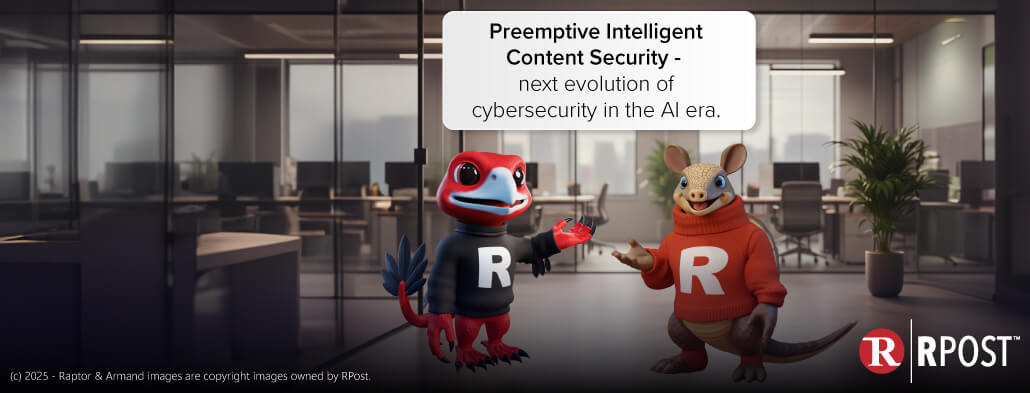
A back-and-forth conversation between Rocky the Raptor (Cybersecurity Evangelist) and Armand the Armadillo (Workflow Automation Evangelist) at RPost
Rocky:
Let’s get straight to it, Armand. Everywhere I go lately, customers are asking the same thing:
“AI is accelerating everything — including risk. How do we protect ourselves?”
And what they really mean is: Do we keep piling more security around the network, or do we move security into the content itself?
Because here’s my take: attackers already moved beyond the network.
Armand:
I hear the same concern — but from a different angle. Customers aren’t just worried about breaches. They’re worried about managing incidents, audits, compliance, and workflow disruption once something goes wrong.
They ask:
And honestly, Rocky, network-only security doesn’t answer those questions anymore.
Rocky:
Exactly. Network security is necessary — but it’s no longer sufficient.
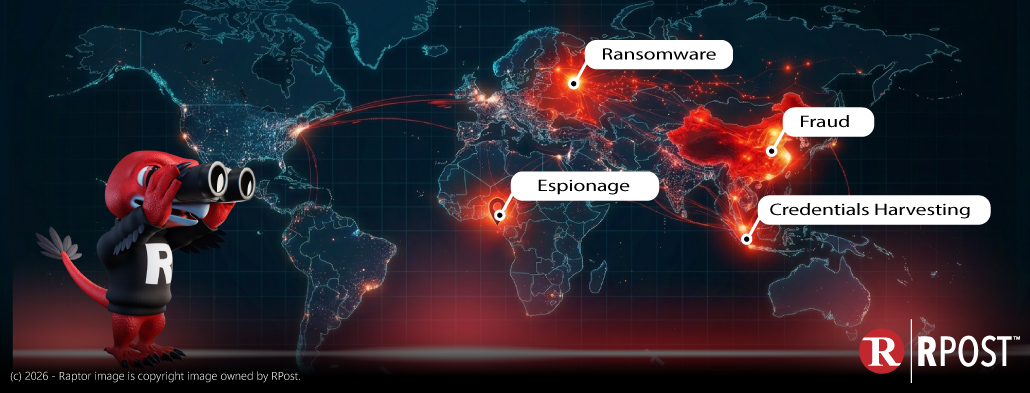
Threat actors today don’t “hack the firewall.” They harvest context.
They compromise:
Then they quietly read emails, documents, images to learn:
That context fuels hyper-contextual, AI-generated lures -- the kind that lead to BEC, ransomware, vendor email compromise, and strategic data exfiltration.
No firewall sees that.
No endpoint agent sees that.
Armand:
And from the workflow side, here’s the uncomfortable truth: Once content leaves your environment, you’ve lost operational control.
Your message.
Your document.
Your image.
Now sitting in:
At that point, security policies stop -- but business risk continues.
That’s why customers are shifting their thinking from incident response to preemptive exposure management.
Rocky:
Which brings us to the big question customers keep asking:
Do we protect the environment -- or do we protect the content?
If AI is being used by attackers to analyze stolen content, then logically, defense must also move to the content layer.
This is exactly why Aragon Research introduced and defined the category Preemptive Intelligent Content Security (PICS) -- and named RPost a Pioneer and Visionary.
They saw what we’re seeing in the field.
Armand:
Right -- Aragon’s insight is key here.
Traditional security focuses on:
But modern workflows are content-centric, not network-centric.
Email is content.
Documents are content.
Records are content.
Images are content.
And content is what:
If you don’t embed intelligence and control into the content itself, you’ll always be reacting after exposure.
Rocky:
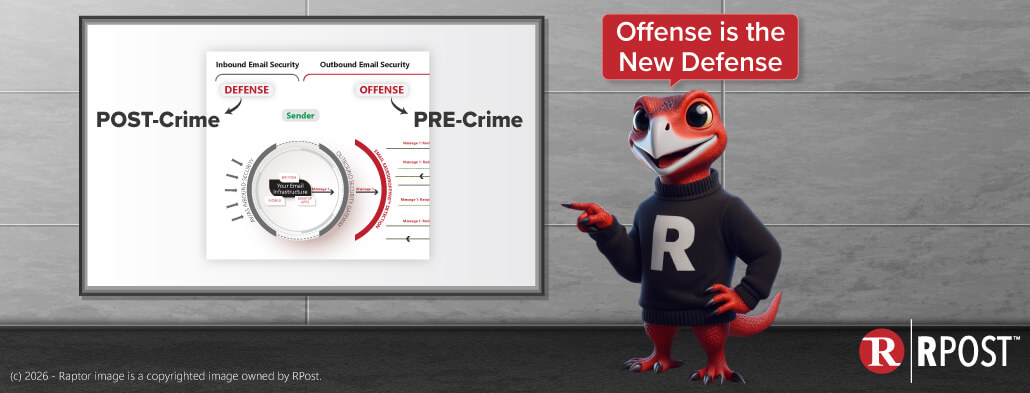
That’s the PRE-Crime™ shift.
Instead of asking:
“How do we respond once the attack happens?”
We ask:
“How do we detect reconnaissance and kill the risk before the attack forms?”
With AI-powered content security, you can:
That’s discovery, visibility, auditing, and exposure management -- tied directly to the content.
Armand:
And from a productivity standpoint, that’s huge.
Because now:
Instead of slowing people down, intelligent content security reduces friction:
Security becomes part of the workflow -- not an obstacle to it.
Rocky:
Which is exactly what Aragon was getting at.
They didn’t say “replace network security.”
They said extend security into the content layer.
Think of it as:
If attackers are using AI to exploit content, defenders must use AI to defend content -- autonomously, preemptively, everywhere it travels.
Armand:
So when customers ask us:
“How do we protect ourselves proactively -- or better yet, preemptively?”
The answer isn’t either/or.
It’s:
That’s the architectural shift.
Rocky (final word):
AI changed the attack surface.
Now it’s changing the defense model.
Security can no longer stop at the network edge or endpoint boundary.
It must travel with the content -- messages, documents, images -- wherever they go.
That’s why Preemptive Intelligent Content Security isn’t a buzzword.
It’s the next logical evolution of cybersecurity in the AI era.
And that’s why Aragon Research saw RPost not just as a participant -- but as a pioneer.
Rocky the Raptor
“Threat actors hunt for context. We hunt them first.”
Armand the Armadillo
“The safest workflows are the ones where security is built in -- not bolted on.”
March 27, 2026
March 20, 2026

March 13, 2026
March 06, 2026

February 27, 2026





 Blog
Blog